Nucleic acid and DNA Replication
Basic DNA structure
- DNA is a
double helix - DNA is made up of
twostrands ofnucleotides - The two strands are
complementary
By complementary, we mean that the sequence of bases on one strand determines the sequence of bases on the other strand because of the
A-TandG-Cbase pairing rules
Purine: Adenine (A), Guanine (G), double ring structure
Pyrimidine: Thymine (T), Cytosine ©, single ring structure
The building blocks of DNA - Nucleotides
A nucleotide is a molecule that forms the basic structural unit of nucleic acids such as DNA. Each nucleotide has three components:
- A Phosphate group
- A sugar 🍬
- A nitrogenous base
Base pairing
- Adenine (A) pairs with Thymine (T), 2 hydrogen bonds between A and T.
- Guanine (G) pairs with Cytosine (C), 3 hydrogen bonds between G and C.
Purines: Adenine (A) and Guanine (G), which have a double ring structure.
Pyrimidines: Thymine (T) and Cytosine (C), which have a single ring structure.
Quiz: If the adenine (A) content of a DNA molecule is 20%, what is the guanine (G) content?
Answer and Explanation
Answer: 30%
Explanation: A + T = 20% + 20% = 40%. G + C = 60%. G = 60%/2 = 30%
The melting temperature of DNA
- The melting temperature of DNA is the temperature at which 50% of the DNA is denatured (i.e. the two strands are separated)
- Factors that affect the melting temperature of DNA:
- pH of the solution
- ion concentration
- GC content (GC: the percentage of guanine and cytosine bases in the DNA molecule)
- length of the DNA molecule
Quiz: What is easier to denature, a DNA molecule with a high GC content or a DNA molecule with a low GC content?
Answer and Explanation
Answer: A DNA molecule with a high GC content
Explanation: GC base pairs are held together by 3 hydrogen bonds, while AT base pairs are held together by 2 hydrogen bonds. Therefore, a DNA molecule with a high GC content is harder to denature than a DNA molecule with a low GC content.
(Why) DNA are the carriers of genetic information
- Very stable and durable
- Store genetic information
⚡️ Overall charge of DNA is negative
RNA is single-stranded. Unstable and degraded easily.
Chromosomes and Chromatin
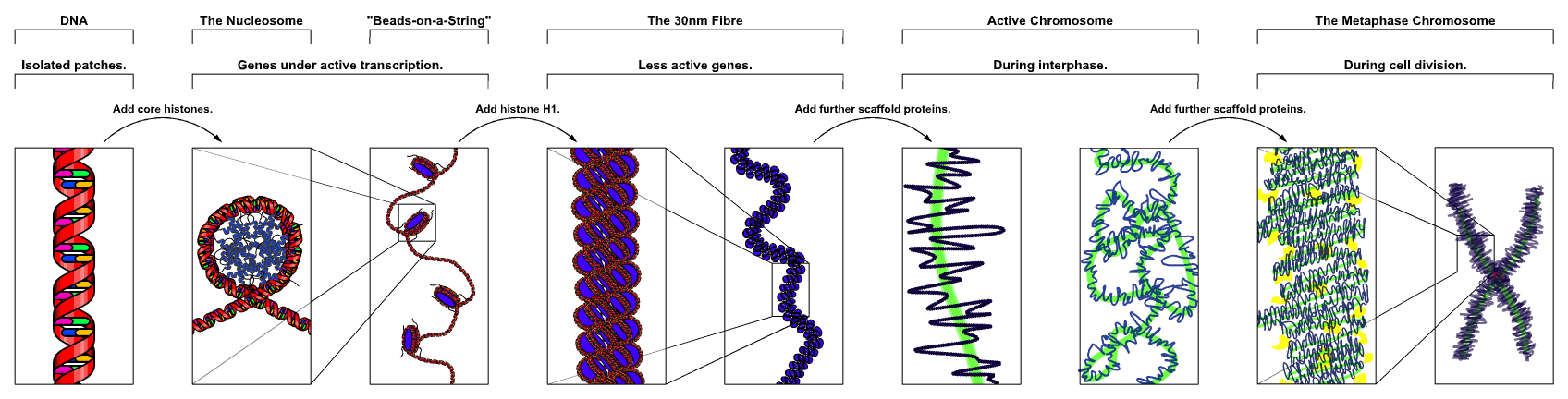
by Richard Wheeler at en.wikipedia, CC BY-SA 3.0 http://creativecommons.org/licenses/by-sa/3.0/, via Wikimedia Commons
- DNA is wrapped around histone proteins to form nucleosomes
- Nucleosomes are further coiled and folded to form chromatin
- Chromatin is further coiled and folded to form chromosomes
- Beads-on-a-string structure: Linker DNA between nucleosomes
So Basically:
- DNA + 8 * histones = Nucleosome
- Multiple nucleosomes + H1 histone = Chromatin
Two types of chromatin
- Euchromatin: loosely packed, transcriptionally active
- Heterochromatin: tightly packed, transcriptionally inactive
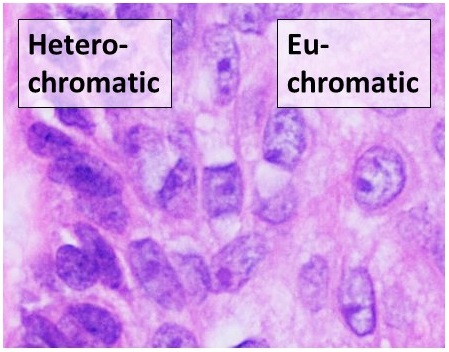
Source
Mikael Häggström, M.D. Author info - Reusing images- Conflicts of interest: None Mikael Häggström, M.D.Consent note: Consent from the patient or patient's relatives is >regarded as redundant, because of absence of identifiable features (List of HIPAA identifiers) >in the media and case information (See also HIPAA case reports guidance)., CC0, via Wikimedia >Commons
DNA Replication
Cell Division Cycle
Cell Cycle
-
Interphase:
- G1: only duplicate cellular contents, not DNA
- S: Duplicate Chromosomes
- G2: Double check chromosomes
-
Mitotic Phase: Mitosis, Cytokinesis (Mitosis: 有丝分裂, Cytokinesis:胞质分裂)
-
G0: resting phase
Interphase
- Chromosomes are in a region of the nucleus called chromosome territories.
Some terms
- Diploid: 2 sets of chromosomes (e.g. humans)
- Haploid: 1 set of chromosomes (e.g. egg and sperm cells)
More terms
Polyploid: 3 or more sets of chromosomes (e.g. wheat, strawberries, bananas)
Nulliploid: 0 sets of chromosomes (e.g. some cancer cells)
- Mitosis (有丝分裂): 1 diploid cell -> 2 diploid cells (identical to the parent cell)
- Meiosis (减数分裂): 1 diploid cell -> 4 haploid cells (half the chromosomes as the parent cell)

by SadiesBurrow, CC BY-SA 4.0 http://creativecommons.org/licenses/by-sa/4.0/, via Wikimedia Commons
During DNA replication
- G1 phase: Cellular contents are duplicated
- S phase:
- Early S phase: Chromosomes have one DNA double helix
- During S phase: Two double helices are formed by DNA replication and binding by
cohesinproteins - Late S phase: Chromosomes have two DNA double helice, Only a few cohesin proteins remain at the centromere
- G2 phase: Double check chromosomes
DNA Replication Properties
- Semi-conservative: Each daughter DNA molecule contains one parental strand and one newly synthesized strand
- Cross-over: Exchange of genetic material between homologous chromosomes
Leading and Lagging Strand

by LadyofHats, Public domain, via Wikimedia Commons
- DNA synthesis Direction (5’ -> 3’) Only
What is 5' -> 3' Direction
5' end of the DNA strand is the end with the phosphate group attached to the 5' carbon of the sugar molecule, 3' end of the DNA strand is the end with the hydroxyl group attached to the 3' carbon of the sugar molecule.
-
Topoisomerase: Relieves the tension of the DNA double helix
-
Helicase: Unwinds the DNA double helix
-
Leading Strand:
- 5’ -> 3’
- Continuous
- Towards the replication fork
- Needs only one primer
- DNA polymerase synthesizes DNA
-
Lagging Strand:
- 3’ -> 5’
- Use Okazaki fragments (short DNA fragments, Discontinuous)
- DNA primase synthesizes RNA primers
- RNA primer Enables DNA polymerase to start DNA synthesis for each Okazaki fragment
- DNA polymerase synthesizes DNA
- FEN1 removes RNA primers
- DNA ligase joins the Okazaki fragments together
The End-Replication Problem
- Due to the 5’ -> 3’ direction of DNA synthesis, the lagging strand cannot be completely replicated
- Telomeres are repetitive DNA sequences at the end of chromosomes
- Telomerase is an enzyme that adds telomere repeats to the ends of chromosomes
- High telomerase activity may be associated with cancer cells
- Low telomerase activity may be associated with aging