Part A: Understanding Genetic Variation
Some Causes of Genetic Variation
- Replication errors
- Sponatneous mutation (自发突变): during DNA
replication
- Hydrolytic damage
- Oxidative damage
- Chemicl damage: caused by chemicals
- Radiation (UV, X-ray, gamma-ray)
- Chemicals (e.g. cigarette smoke)
Types of Genetic Variation
DNA replication errors
DNA polymerase could insert the wrong nucleotide, corrected by
proofreadingCommonly occur in short tendem repeats
Unequal crossover (UEC)
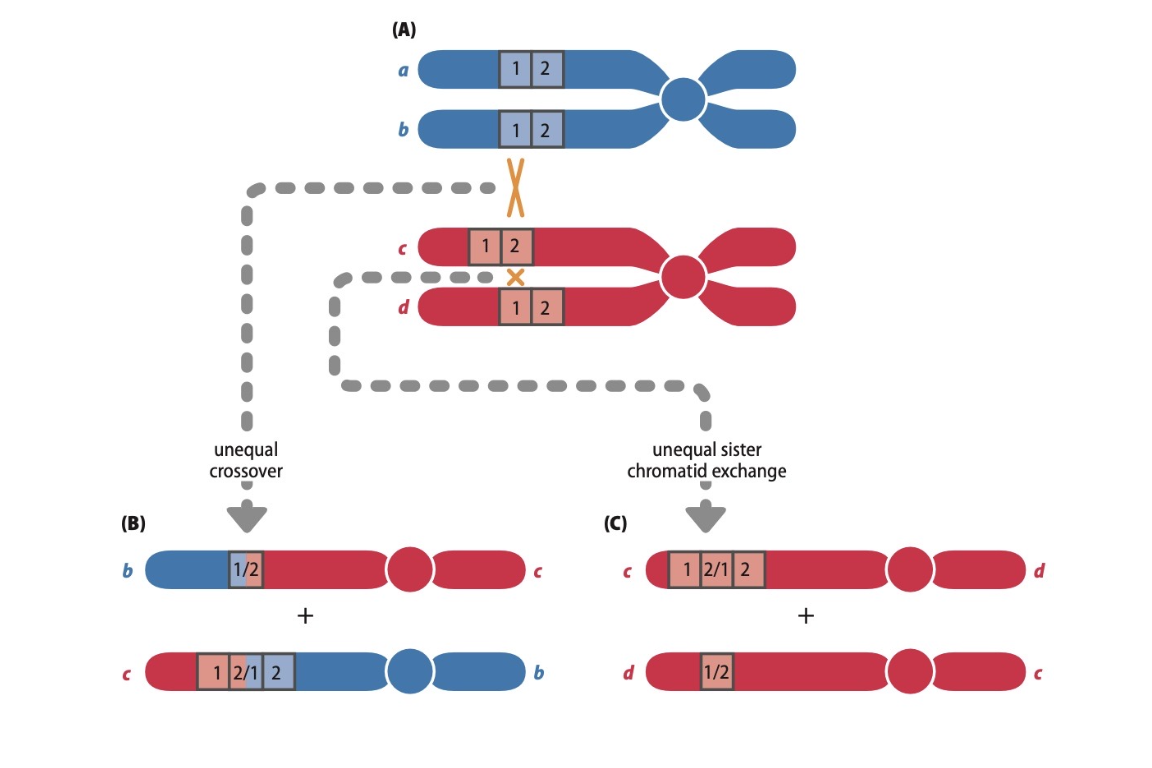
Tom Strachan; Anneke Lucassen. Genetics and Genomics in Medicine: CRC Press, 2022. ISBN 9780367490812
Chromosomal segregation errors
Causing wrong number of chromosomes in gametes: trisomy,
monosomy
Small-scale variation
Single base-pair substitution (Transition vs. Transversion)
- Transition: purine to purine (A <-> G) or pyrimidine to pyrimidine (C <-> T)
- Transversion: purine to pyrimidine or pyrimidine to purine (A <-> C, A <-> T, G <-> C, G <-> T)
SNV (Single nucleotide variant) (Synonymous vs. Non-synonymous)
- Synonymous: no change in amino acid (ACC (Thr) -> ACA (Thr))
- Non-synonymous: change in amino acid
- Missense: change in amino acid (AGT (Ser) -> AGG (Arg))
- Nonsense: change in amino acid to stop codon (TGG (Trp) -> TGA (Stop))
- Stop-loss: stop codon to amino acid (TGA (Stop) -> TGC (Cys))
Conservative vs. Non-conservative
- Conservative: Same Chemical class
- Non-conservative: Different Chemical class
Splicing Mutation
- e.g. skipping of exon, retention of intron, extension of exon
- web tools to predict splicing mutation: GeneSplicer, Human Splicing Finder
Small insertion/deletion (indel) (<50 bp)
- Frameshift Mutation: insertion/deletion of a number
of nucleotides
- Lead to premature stop codon
- Degradation of mRNA by nonsense-mediated decay (NMD)
- Sometimes, translate to a longer protein, which could infect the function of the normal protein
Large-scale variation
Structural variation (>50 bp) (balanced vs. unbalanced)
- Types: Insertion, Deletion, Duplication, Inversion, Translocation
- Can cause copy number variations
- Effects on gene expression and protein function
Variants in gene regulation
- Transcription factor binding sites
- Affects Transcription factor binding motifs (TFBMs)
Effects of Mutation
A change in the sequence of the gene:
- Gain of function
- Loss of function
- Altered function
Change in gene expression levels:
- Copy number variation
- Change in gene regulation
- Premature termination codon
1.5B DNA Damage and Repair
DNA repair pathways
- Direct reversal of damage
- O6-alkyl guanine-DNA alkyltransferase (ATase)
- Photolyase
- AlkB
- Nucleotide excision repair (NER)
- UV damage
- Bulky adducts
- Base excision repair (BER)
- Base and sugar-phosphate backbone damage
- DNA single strand breaks (SSBs)
- DNA damage tolerance
- Translesion polymerases
Why DNA repair is important
DNA is the only molecule that can be
repaired, others arereplaced5%of proteins are involved in DNA repairCancer
- Polygenic disease requiring changes in several class of genes.
- Steps:
- Loss of Genome Stability
- Loss of a tumor suppressor gene
- Activation of an oncogene
- Escape from cell death process
- Amplification of signal cascades
DNA repair for cancer therapy:
- Good:
- Defend against exogenous and endogenous agents
protect against cancer
- Bad:
Resistance to therapy- responsible for chromosomal translocations
Main forms of DNA damage
- Single strand breaks
- Mismatches
- Damaged bases
- Double strand breaks
- Intra-strand crosslinks
- Inter-strand crosslinks
DNA repair pathways
Direct reversal
Removal of O6-alkyl groups by the suicide protein O6-ATase
Base excision repair
Base excision repair in Human Cells.
Lesion recognition in base excision repair - 'nucleotide flipping' is a common theme
Nucleotide excision repair
Recognise distorition
Formation of structure & recognition of damaged strand
Dual incision by structure-specific endonucleases
Excision DNA repair synthesis
Failed Transcription-coupled repair:
Cockayne syndrome
DNA Damage tolerance
Nearly all DNA lesions block DNA polymerase synthesis, and replication in S-phase
- Interconnections and redundancy across repair pathways