Important Terminologies and Concepts
Terminology
- Locus: The unique chromosomal location of a DNA sequence or an individual gene.
- Allele: Individual copy of a gene or other DNA sequence on a single chromosome.
- Allele frequency: Frequency of an allele at a genetic locus in a population.
- Minor allele frequency (MAF): Frequency of the second-most-common allele at a genetic locus in a given population.
- Phenotype: Observable characteristics of a person, an organ, or a cell, arising from differential gene expression.
- Genotype: Combination of alleles that a person
possesses at a single locus or number of loci.
- Homozygous: Both alleles are the same at a certain locus.
- Heterozygous: Alleles are different at a locus.
- Hemizygous: Only one copy of the allele is present in a diploid cell (e.g., sex-linked genes in males).
Genetic and Environmental Determinants in Human Diseases
- Monogenic: Rare diseases with high recurrence rates within families, following Mendelian inheritance.
- Environmental: Influences such as diet and exposure to chemicals.
- Multifactorial: Common diseases with complex genetics and low recurrence rates within families.
| Characteristic | Monogenic Traits | Multifactorial/Complex Traits |
|---|---|---|
| Genetic Basis | Single gene (Mendelian inheritance) | Multiple genes (polygenic inheritance) |
| Occurrence | Rare | Common |
| Penetrance | High | Variable |
| Phenotype Specificity | Specific phenotype linked to a single gene | Variable phenotypes influenced by many factors |
| Inheritance Patterns | Mendelian (AD, AR, X-linked, mitochondrial) | Complex, often not following Mendelian patterns |
| Environmental Influence | Usually low or specific (e.g., triggers) | High, often a significant factor |
| Examples | Cystic fibrosis, Sickle cell disease | Diabetes, Heart disease, Certain cancers |
| Risk Assessment | Predictable based on Mendelian inheritance | Complex, involves statistical models |
Approaches used to identify the genetic basis of inherited diseases
- Linkage Analysis
- Description: Studies families through generations to find DNA markers co-segregating with the disease.
- Use: Identifying the chromosomal location of monogenic disease genes.
- Candidate Gene Approach
- Description: Tests specific genes based on their known function or position in a linkage region.
- Use: Hypothesis-driven testing of genes suspected of being involved in a disease.
- Genome-Wide Association Studies (GWAS)
- Description: Scans genomes to find genetic variations associated with diseases across large populations.
- Use: Useful for identifying genetic factors in complex, multifactorial diseases.
- Whole Exome Sequencing (WES)
- Description: Sequences all protein-coding regions in the genome to find mutations.
- Use: Identifying novel mutations in known disease-causing genes.
- Whole Genome Sequencing (WGS)
- Description: Involves sequencing the entire genome, including all coding and non-coding regions.
- Use: Comprehensive analysis for complex diseases or unidentified mutations.
- Functional Genomics
- Description: Studies expression and interaction of genes and proteins to understand their roles.
- Use: Understanding biological functions and disease mechanisms at the molecular level.
- Bioinformatics and Computational Biology
- Description: Uses algorithms and computational methods to analyze and interpret biological data.
- Use: Analyzing genomic data, predicting genetic variant impacts, and
Categories of Genetic Disorders
- Single-gene (Monogenic): Rare diseases mainly determined by a single gene locus, following Mendelian inheritance patterns.
- Mitochondrial: Diseases caused by mutations in mitochondrial DNA.
- Chromosomal: Includes structural and numerical abnormalities in chromosomes.
Specific Types of Inheritance
- Autosomal Dominant: Disease manifested in heterozygotes, often with affected offspring having an affected parent.
- Autosomal Recessive: Disease manifested in homozygotes or compound heterozygotes, often with unaffected carrier parents.
- X-Linked Recessive: Mostly affects males born to unaffected parents, with the affected allele not being transmitted from father to son.
Specific Disorders
- Familial Hypercholesterolemia (FH): Autosomal dominant disorder often caused by loss-of-function mutations in the LDL-receptor gene or apolipoprotein B gene.
- Mitochondrial DNA Disorders: Characterized by
matrilineal inheritance (
only through the mother), affecting individuals of either sex.
Basis and Modes of Mendelian Inheritance
Mendelian inheritance, named after Gregor Mendel, forms the foundation for understanding how traits and diseases are passed down through generations. It is characterized by the transmission of discrete units of inheritance, or genes, from parents to offspring.
Key Concepts of Mendelian Inheritance
Terminology
Genes and Alleles
- Gene: A segment of DNA that codes for a specific trait.
- Allele: Different forms of a gene. Each individual inherits two alleles for each gene, one from each parent.
Dominant and Recessive Traits
- Dominant Allele: An allele that can express its trait even if only one copy is present (heterozygous condition).
- Recessive Allele: An allele that expresses its trait only when two copies are present (homozygous condition).
Genotype and Phenotype
- Genotype: The genetic makeup of an individual, representing the combination of alleles inherited from parents.
- Phenotype: The observable physical or biochemical characteristics of an organism, as determined by both genetic makeup and environmental influences.
Modes of Inheritance
See Modes of Inheritance for more details.
Features of Mitochondrial DNA Disorders
Mitochondrial DNA disorders are caused by mutations in mitochondrial DNA, which is distinct from nuclear DNA and exhibits unique inheritance and biological features. These disorders often affect organs and systems with high energy demands.
Key Characteristics
Maternal Inheritance
- Source: Mitochondrial DNA is exclusively inherited from the mother, as mitochondria in the sperm are typically destroyed after fertilization.
- Transmission: All children of an affected mother have a risk of inheriting the mutations, but affected fathers do not pass the disorder to their offspring.
Heteroplasmy and Homoplasmy
- Heteroplasmy: The presence of both normal and mutated mitochondrial DNA in the same cell. Severity and symptoms can vary depending on the proportion of mutated mtDNA.
- Homoplasmy: All mitochondrial DNA in each cell is identical (either all normal or all mutated). Typically results in more uniform presentation of the disease.
High Energy Demand Organs Affected
- Organ Involvement: Primarily affects organs with high energy requirements like the brain, heart, muscles, and sensory organs.
- Symptoms: Can include muscle weakness, neurological issues, heart problems, diabetes, and sensory deficits.
Variable Expression
- Symptom Variation: Due to heteroplasmy, symptoms can vary widely, even among members of the same family.
- Age of Onset: Can appear at any age, from infancy to adulthood.
Multi-System Disorders
- Complex Symptoms: Patients often present with a combination of symptoms affecting multiple systems.
- Examples: Mitochondrial encephalomyopathy, lactic acidosis, and stroke-like episodes (MELAS); Leber's hereditary optic neuropathy (LHON); Kearns-Sayre syndrome.
Mitochondrial Dysfunction
- Cellular Impact: Mutations impair the mitochondria's ability to generate ATP, leading to energy deficits in cells.
- Secondary Effects: Can lead to increased production of reactive oxygen species, contributing to further cellular damage.
Diagnosis and Management
- Diagnostic Challenges: Due to the wide range of symptoms and overlap with other disorders.
- Management: Primarily supportive and symptomatic, as there is currently no cure. Includes physical therapy, nutritional support, and management of specific symptoms.
Main Forms and Causes of Chromosomal Abnormalities
Chromosomal abnormalities occur when there is a deviation from the normal number or structure of chromosomes, leading to various health and developmental issues. They can be broadly classified into numerical and structural abnormalities.
Numerical Abnormalities
Aneuploidy
- Description: An abnormal number of chromosomes.
- Causes: Often due to nondisjunction during meiosis, where chromosomes fail to separate properly.
- Examples:
- Trisomy: An extra chromosome (e.g., Trisomy 21, Down syndrome).
- Monosomy: A missing chromosome (e.g., Turner syndrome, 45,X).
Polyploidy
- Description: A condition where cells contain more than two complete sets of chromosomes.
- Types:
- Triploidy: Three sets of chromosomes (69 chromosomes).
- Tetraploidy: Four sets of chromosomes (92 chromosomes).
- Cause: Typically due to errors in cell division.
Structural Abnormalities
Deletions
- Description: A segment of the chromosome is missing or deleted.
- Impact: Can lead to various syndromes depending on the genes located in the deleted segment.
Duplications
- Description: A segment of the chromosome is duplicated, leading to extra genetic material.
- Consequences: Can cause developmental and physical abnormalities.
Translocations
- Description: A segment of one chromosome is transferred to another chromosome.
- Types:
- Reciprocal Translocation: Segments from two different chromosomes are swapped.
- Robertsonian Translocation: The long arms of two acrocentric chromosomes fuse at the centromere, forming a single chromosome.
- Impact: Can be harmless or cause genetic disorders depending on the involved genes and breakpoints.
Inversions
- Description: A chromosome segment is reversed end to end.
- Types:
- Paracentric Inversion: Inversion does not include the centromere.
- Pericentric Inversion: Inversion includes the centromere.
- Effect: May lead to abnormal gene function if it disrupts a gene sequence.
Ring Chromosomes
- Description: A chromosome forms a ring due to deletions in telomeres, causing the ends to fuse.
- Impact: Varies widely, can cause developmental delays, growth retardation, and other anomalies.
Isochromosomes
- Description: Formation of a chromosome with identical arms due to abnormal division of the centromere.
- Effect: Leads to duplication of one arm and loss of the other, causing genetic imbalances.
Common Causes
Errors in Meiosis
- Nondisjunction: Improper separation of chromosomes or chromatids.
- Unbalanced Gametes: Leading to trisomies or monosomies in the offspring.
Errors in Mitosis
- Somatic Cell Mutations: Can lead to mosaicism, where some cells have normal karyotypes while others have chromosomal abnormalities.
Inherited Structural Changes
- Parental Chromosome Abnormalities: Can be passed down to offspring, especially balanced translocations or inversions.
Environmental Factors
- Advanced Parental Age: Especially maternal age, increases the risk of nondisjunction.
- Exposure to Certain Chemicals or Radiation: Can cause chromosomal breaks and rearrangements.
Drawing and Interpreting Pedigree Diagrams
Basics of Pedigree Diagrams
Symbols
- Circle: Represents a female.
- Square: Represents a male.
- Diamond: Represents an individual whose sex is unknown.
- Filled Symbol: Indicates an individual affected by the trait or condition being studied.
- Empty Symbol: Represents an individual not affected by the trait.
- Horizontal Line Connecting a Circle and Square: Represents a mating or marriage.
- Vertical Line from Mating Line: Leads to offspring symbols.
- Roman Numerals on the Left: Denote generations (I, II, III, etc.).
- Arabic Numerals Under Symbols: Denote individuals within a generation (1, 2, 3, etc.).
Specific Cases
- Carriers (in case of recessive traits): Half-filled symbols or a dot in the center.
- Deceased Individuals: A diagonal line across the symbol.
- Twins: A triangle connecting the individuals to the
vertical line from the mating line.
- Identical Twins: A single line connecting the twins.
- Fraternal Twins: Individual lines connecting each twin.
Interpreting Pedigree Diagrams
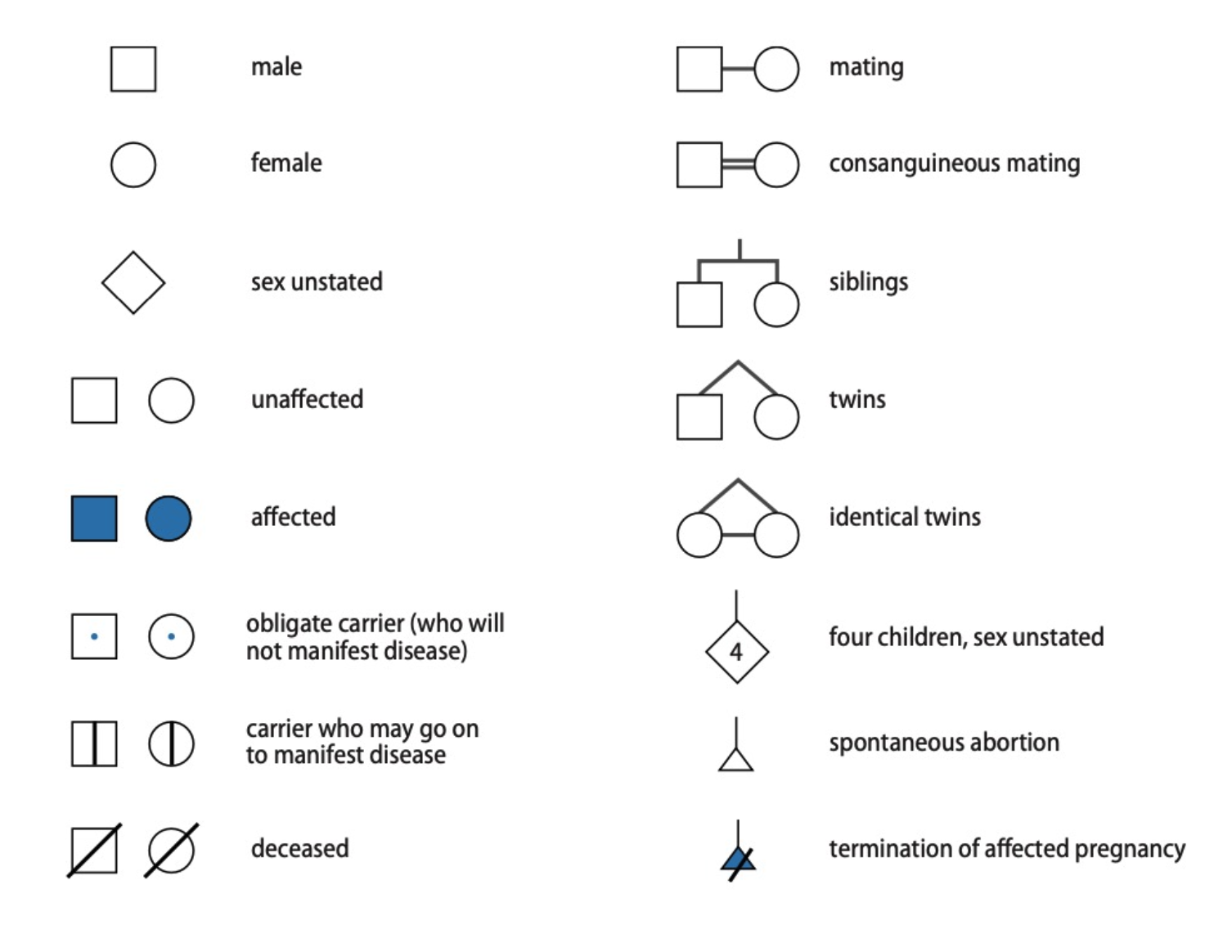
Tom Strachan; Anneke Lucassen. Genetics and Genomics in Medicine: CRC Press, 2022. ISBN 9780367490812
Autosomal Dominant Inheritance
- Appears in every generation.
- Both males and females are equally likely to be affected.
- Affected individuals usually have an affected parent.
Autosomal Recessive Inheritance
- Can skip generations.
- More likely to appear in consanguineous matings.
- Males and females are equally affected.
- Carriers are asymptomatic.
X-Linked Recessive Inheritance
- More males are affected.
- No male-to-male transmission (affected males do not pass the trait to their sons).
- Carrier females can pass the trait to their sons.
X-Linked Dominant Inheritance
- Both males and females are affected, often more females.
- No father-to-son transmission, but fathers can pass it to all daughters.
- Appears in every generation.
Y-Linked Inheritance
- Only males are affected.
- Passed from father to all sons.
Mitochondrial Inheritance
- Passed from mother to all children, both males and females.
- Fathers do not pass mitochondrial DNA to their children.
Example Pedigree Interpretation
- If a trait appears in every generation and affects both males and females equally, it's likely autosomal dominant.
- If a trait appears predominantly in males and skips generations, it's likely X-linked recessive.
Susceptibility Genes for Complex Diseases
Common complex diseases disorders with non-Mendelian inheritance
- Phenotype is caused by
2 or more genes Environmental factors- Phenotype varies along a
continual gradient
Examples:
Type 1 diabetes,obesity,asthma,hypertension
Limited success with Linkage analysis
Example:
Crohn's disease,
Candidate gene association studies
Example:
HIV-1
Genome-wide polygenic risk scores (PRS)
Use risk prediction models to calculate the cumulative effect of multiple genetic variants on disease risk
Potential for clinical use as a stratification tool
Example: Colorectal cancer
Phenome-wide association studies (PheWAS)
Some genes cause multiple different conditions
(pleiotropy)
pleiotropy: A single gene having multiple phenotypic effects
connect diseases and traits in unexpected ways
Susceptibility Genes for Complex Diseases
Association studies
- Large population-based studies, population stratification issues
- Need for replication, use of imputation and meta analysis
Identify causal sequence variants
- Chanllenging due to no single mutation is necessary or sufficient for disease
- Hard to find map associations due to linkage disequilibrium
- Often involve non-coding regions
GWAS
- high significant but small effects
- Many loci involved
- Only a small fraction of genetic risk explained